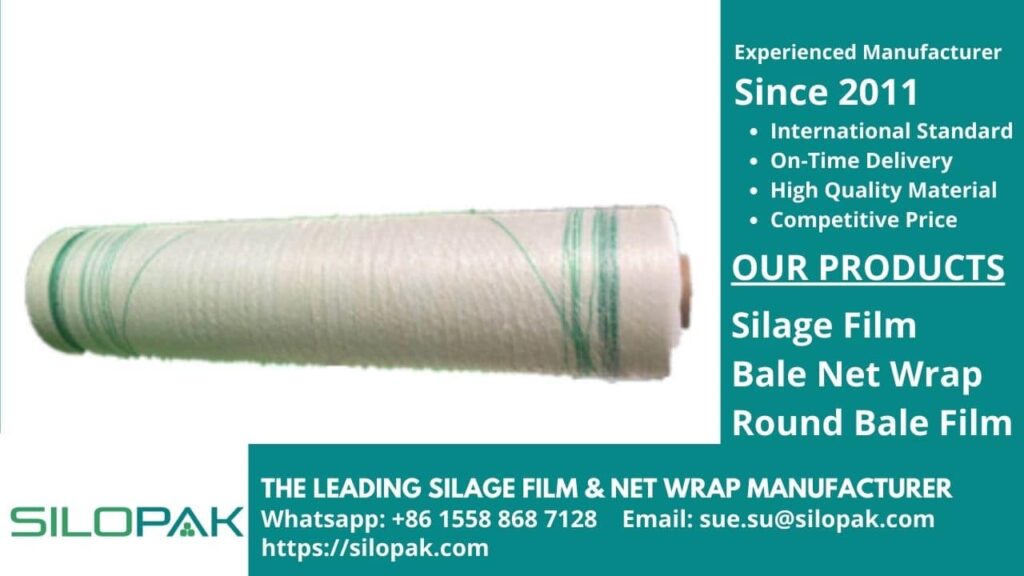
Net wrap looks simple: a roll of mesh that binds a bale. How it is made, and from what, is what separates a product that holds a dense bale through a season of weather from one that tears in the baler or crumbles in the sun. This guide explains how net wrap is manufactured, why the raw material matters so much, and what distinguishes a good manufacturer from a poor one.
The Right Material: HDPE
Net wrap is made from High-Density Polyethylene (HDPE), a thermoplastic polymer produced from ethylene. HDPE is chosen because it offers an excellent strength-to-weight balance: it is light enough to handle in large rolls yet strong enough to hold a heavy, dense round bale without stretching or breaking.
HDPE is produced by polymerization, the process of joining many small ethylene molecules (monomers) into long polymer chains. It is worth clearing up a common confusion here: polymerization is not the same as cracking. Cracking is the opposite process, breaking large hydrocarbon molecules down into smaller ones such as ethylene. Polymerization then builds those small ethylene monomers back up into the long-chain polyethylene that net wrap is made from. The two are sequential steps, not the same thing.
How Net Wrap Is Manufactured
Producing net wrap runs through two main stages.
First, the HDPE resin is extruded into a wide, thin film, which is wound into a large primary roll. Second, that film is slit into narrow tapes, and those tapes are knitted together on specialized looms into the open mesh structure that gives net wrap its characteristic form. The knitting pattern and tape strength together determine how well the finished net holds a bale.
The molecular arrangement matters throughout. During extrusion, the polymer chains are oriented along the strand, which is what gives the resulting tape its high tensile strength in the direction that counts.
The Light-Versus-Heavy Problem
Here is the central challenge in net wrap manufacturing, and it is where good and poor manufacturers diverge.
The crude way to make net wrap stronger is to use more material: heavier, thicker tape. It works, but it produces a roll that is heavier and larger in diameter. That creates a practical problem, because balers have limited space for the net wrap roll, and there is a limit to the weight an operator can handle.
This becomes a real constraint when longer rolls are wanted. A longer roll means fewer changes in the field, which is a genuine efficiency gain, but with heavy standard material, a longer roll quickly becomes too big in diameter and too heavy to fit and handle. Simply piling on more material to get both length and strength runs into a physical ceiling.
The better solution is not more material but better material.
Why the Grade of HDPE Matters
Not all HDPE is equal, and this is where manufacturing quality shows.
Higher-grade resins produce polymer with greater strength for the same weight of material. Lower-grade resins produce a weaker product at the same weight, so the manufacturer has to add more material to reach an acceptable strength, which brings back the weight and diameter problem.
Less sophisticated manufacturers are stuck in this trap. Relying on standard or low-grade resin and older production methods, they can only reach minimum strength by using heavier material, which limits how long and how manageable their rolls can be.
More advanced manufacturers use higher-grade, purpose-formulated HDPE resin together with modern production techniques. This lets them produce net wrap that is lighter and yet stronger than standard-material equivalents, which in turn allows longer rolls that still fit the baler and remain manageable to handle. The difference is not marketing; it is the resin grade and the process behind it.
“The question we get from serious buyers is not just how strong the net is, but how much length they get on a roll that still fits their baler. Those two pull against each other with cheap material, because the only way to get strength from low-grade resin is to add weight, and weight limits length. Good resin resolves the tension: you get strength and length without an unmanageable roll. That is really what separates the manufacturers.”
— Sue Su, Marketing Director of Silopak
What Separates a Good Net Wrap Manufacturer
| Factor | Capable Manufacturer | Poor Manufacturer |
|---|---|---|
| Raw material | Higher-grade virgin HDPE | Low-grade or recycled resin |
| Strength-to-weight | Strong at lower weight | Needs heavy material for basic strength |
| Roll length options | Longer rolls that still fit the baler | Limited by roll weight and diameter |
| UV stability | Properly UV-stabilized, resists field degradation | Degrades and crumbles under UV |
| Field performance | Holds through baling, handling, storage | Tears and fragments |
The Environmental Angle
Net wrap quality has a genuine environmental dimension, and it is worth being straight about it.
Poor-quality net wrap degrades quickly under UV and handling, crumbling into small plastic fragments that then persist in the environment for a very long time. Those fragments do real harm: they scatter across fields, and if they end up in feed, they cannot be digested by livestock. A wrap that fails is both an economic loss and an environmental one.
Producing lighter, stronger net wrap helps on both counts. Using higher-grade resin means significantly less plastic for the same length and strength, so there is less material to dispose of per bale wrapped. And because the wrap is durable, it holds together rather than fragmenting into the field.
Two honest caveats belong here, consistent with what we tell every customer. First, net wrap must always be removed before feeding, because polyethylene does not digest in the rumen and accumulates there regardless of quality or grade. Second, while HDPE net wrap is recyclable in principle, practical recycling depends on local collection infrastructure and on keeping the used wrap clean. Durability and correct disposal matter more than recyclability claims alone.
Silopak manufactures bale net wrap from virgin UV-stabilized HDPE, focused on strong, long, manageable rolls that perform in the field and hold together rather than fragmenting. For guidance on matching net wrap to your machine, see our guide on net wrap for round balers.
Frequently Asked Questions
Q: What material is net wrap made from?
Net wrap is made from High-Density Polyethylene (HDPE), a thermoplastic polymer produced from ethylene. HDPE is chosen for its strength-to-weight balance: light enough to handle in large rolls, strong enough to hold a dense round bale without breaking. The film is extruded, slit into narrow tapes, and knitted into the open mesh that forms the net. The grade of HDPE used has a major effect on the finished product’s strength and durability.
Q: Is polymerization the same as cracking?
No, they are opposite processes. Cracking breaks large hydrocarbon molecules down into smaller ones, which is how ethylene is produced from petroleum feedstock. Polymerization then joins those small ethylene molecules into the long polymer chains that make up polyethylene. They are sequential steps in producing the raw material for net wrap, not the same process. Describing polymerization as cracking is a common but real error.
Q: Why is some net wrap lighter but still strong?
Because it is made from higher-grade, purpose-formulated HDPE resin combined with modern production methods. Higher-grade resin delivers more strength per unit of weight, so the manufacturer does not need to add heavy material to reach the required strength. This allows lighter net wrap that is still strong, which in turn allows longer rolls that fit the baler and remain manageable to handle. Lower-grade resin cannot do this, forcing weaker or heavier products.
Q: Is net wrap recyclable?
HDPE net wrap is recyclable in principle, but practical recycling depends on local collection infrastructure and on the used wrap being kept reasonably clean. In many regions, organized agricultural plastic collection exists and is expanding. Two points matter more than recyclability claims alone: choosing durable wrap that holds together rather than fragmenting into the environment, and always removing wrap from bales before feeding, since polyethylene does not digest in the rumen and accumulates there regardless of its recyclability.
Reviewed by Sue Su, Marketing Director of Silopak, on 15 September 2026. This guide has been revised to correct the description of polymerization and to clarify the environmental and recycling points around net wrap.