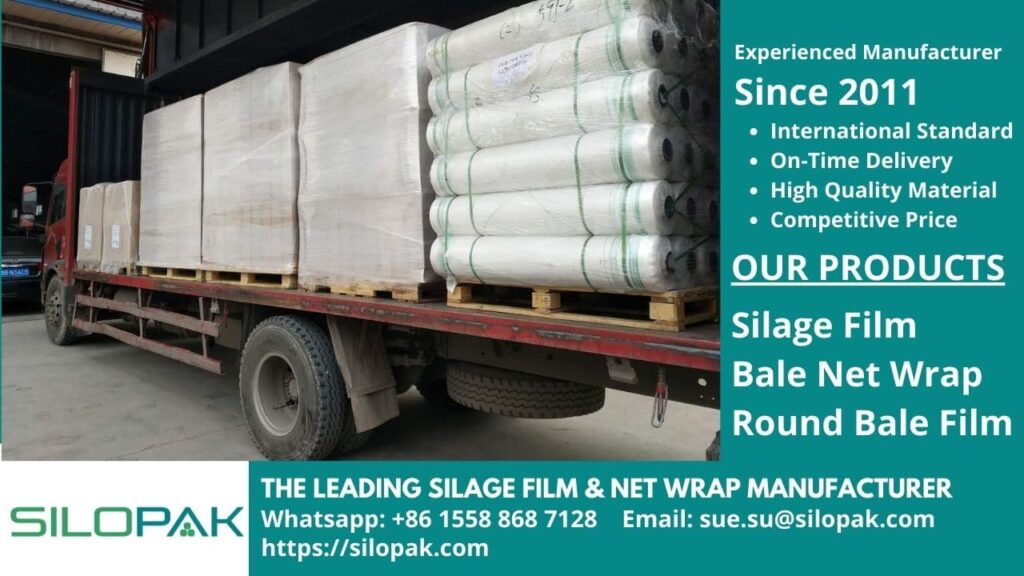
Net wrap costs more than baler twine, often about twice as much per bale. So the honest question for any farmer or contractor is not whether net wrap is “better” in some general sense, but whether the benefits pay for that extra cost on your own farm. For most people baling round bales that are stored outdoors, the answer is yes, and by a clear margin. For some others, it is not.
The benefits of crop baling net wrap come down to three things you can actually measure: how many bales you make per hour, how much forage you lose while baling, and how much you lose while the bales sit in storage. University research has put numbers on all three. This guide sets those numbers out, shows how to work out the cost and the saving per bale for your own operation, explains how many bales you can expect from a roll, and covers the situations where twine is still the sensible choice.
It also corrects a few points from the earlier version of this page, including what net wrap does on a silage bale and what the handles on a net wrap roll are actually for.
What Crop Baling Net Wrap Does, and What It Does Not
Crop baling net wrap is a knitted mesh of high-density polyethylene (HDPE) that a round baler wraps around the outside of the bale before ejecting it. Its job is structural. It holds the bale at full density, keeps the shoulders tight, and gives the bale a smooth, even surface. On dry hay and straw bales stored outdoors, that smooth, tight surface also sheds rain better than a bale tied with twine.
What net wrap does not do is seal a bale. The earlier version of this page said that net wrap “can easily tackle” moisture for fermented feed such as silage. That is not correct. The mesh is open, so air and water pass through it. On a silage bale, net wrap holds the shape, and stretch film applied over it provides the airtight seal that fermentation needs. The real danger for silage is also oxygen rather than moisture: air reaching wet forage lets yeasts and moulds grow, and that is what causes silage to heat and spoil.
On dry hay, the same open structure is an advantage, because dry hay needs to breathe. Sealing dry hay in film traps residual moisture and encourages mould, so net wrap or twine plus covered, elevated storage is the right system. Our guide to hay moisture explains the safe baling moisture for each bale type.
Benefit 1: You Make More Bales per Hour
The first benefit shows up in the field. Twine is applied by feeding strands back and forth across a rotating bale, and Field Crop News reports that a round bale needs about 20 to 30 turns to tie it with twine. Net wrap covers the whole width of the bale at once and needs only about 1¼ to 2½ turns. Those extra rotations are time the baler is standing still with a full chamber.
The result is a significant gain in capacity. Research by Dr Kevin Shinners at the University of Wisconsin, reported by Field Crop News and cited by University of Georgia Extension, found that a baler using net wrap can make up to 32 percent more bales per hour than one using twine. Fewer rotations per bale also mean less fuel and less wear on the baler for every bale produced.
That matters most when the weather window is short. In a climate where hay or baleage has to be made between showers, a third more bales per hour can be the difference between getting the whole crop in and leaving part of it to be rained on. For contractors paid by the bale, it is also extra income from the same machine and the same day.
Benefit 2: You Lose Less Forage During Baling
The extra rotations needed for twine do not just cost time. While the bale turns in the chamber waiting to be tied, leaves and fine material are knocked off the outside and fall through the baler. The same Wisconsin research found dry matter losses during wrapping of 1.0 percent with net wrap compared with 2.9 percent with twine.
That gap matters most with leafy forages such as alfalfa and clover, where the leaves carry most of the protein. Losing nearly 2 percentage points of the bale at the baler is not a dramatic number on its own, but it applies to every single bale and it comes disproportionately from the most valuable part of the crop.
Benefit 3: Bales Keep Better in Outdoor Storage
The largest benefit usually comes later, once bales are stored. For bales stored outside on the ground, the Wisconsin research found total dry matter losses of 11.3 percent for twine-tied bales and 7.3 percent for net-wrapped bales. Kentucky research cited by UGA Extension ranked outdoor storage losses in the same order: twine highest, net wrap lower, and plastic film lowest. UGA notes that net-wrapped bales typically lose 5 to 8 percent of dry matter in the first year outdoors and a further 2 to 5 percent the following year.
The reason is the bale surface. Net wrap holds the outer layer tight and even, so rain runs off rather than soaking in between strands of twine, and the bale holds its shape instead of sagging and flattening. A flattened bale has more surface in contact with damp ground, which is where much of the outdoor loss happens.
One caveat is worth stating. Oklahoma State University found that when outer-layer density is comparable, storage losses for net-wrapped and twine-tied bales can be similar, although net wrap still sheds water better. In practice, net wrap makes it easier to achieve that tight outer layer consistently. And no wrap replaces good storage: getting bales off the ground and under cover reduces losses far more than the choice between net and twine.
Doing the Numbers: Cost per Bale Versus Saving per Bale
The earlier version of this page argued for net wrap without putting any numbers on it. The case is stronger when you calculate it for your own operation, using your own bale weight, your own hay value and your own net wrap price.
Field Crop News, using 2013 prices, put wrap material at roughly 50 cents per bale for twine and about $1 for net wrap, and UGA Extension estimated net wrap at $0.30 to $0.50 more per bale than twine. Prices have changed since then, so use your current quotes. The saving side of the calculation looks like this:
| Step | Calculation | Worked Example |
|---|---|---|
| 1. Bale dry matter | Bale weight × DM% | 500 kg DM per bale (assumed) |
| 2. Loss with twine | Baling loss + outdoor storage loss | 2.9% + 11.3% = 14.2% |
| 3. Loss with net wrap | Baling loss + outdoor storage loss | 1.0% + 7.3% = 8.3% |
| 4. Forage saved per bale | Bale DM × (step 2 − step 3) | 500 kg × 5.9% ≈ 29.5 kg DM |
| 5. Value saved per bale | Forage saved × your hay value per kg DM | Use your local hay price |
| 6. Compare | Value saved vs extra cost of net over twine | Net pays if step 5 exceeds the extra cost |
The loss figures in the example come from the Wisconsin research for bales stored outside on the ground, so they apply to that situation. If your bales are stored under a roof, the storage gap shrinks sharply and the case for net wrap rests mostly on the faster baling. Even so, the example shows why net wrap is so widely used: around 30 kg of dry matter saved per bale is usually worth considerably more than the extra cost of the wrap, before counting the extra bales per hour.
How Many Bales Will One Roll of Net Wrap Cover?
Knowing how many bales a roll will wrap lets you work out your true cost per bale and plan how many rolls to buy for the season. The calculation is straightforward: the net used per bale is the bale circumference (π × diameter) multiplied by the number of turns, and bales per roll is the roll length divided by that figure.
| Bale Diameter | Turns | Net per Bale | 2,000 m Roll | 3,000 m Roll | 3,600 m Roll |
|---|---|---|---|---|---|
| 1.2 m | 2 | 7.5 m | ≈265 bales | ≈397 bales | ≈477 bales |
| 1.2 m | 2.5 | 9.4 m | ≈212 bales | ≈318 bales | ≈381 bales |
| 1.2 m | 3 | 11.3 m | ≈176 bales | ≈265 bales | ≈318 bales |
| 1.5 m | 2 | 9.4 m | ≈212 bales | ≈318 bales | ≈381 bales |
| 1.5 m | 2.5 | 11.8 m | ≈169 bales | ≈254 bales | ≈305 bales |
| 1.5 m | 3 | 14.1 m | ≈141 bales | ≈212 bales | ≈254 bales |
These are theoretical maximums. They do not include the small amount of net used to start each wrap or any wastage when a roll is changed, so real counts will be slightly lower. They also show why a guaranteed minimum roll length matters. A roll that is 10 percent short delivers 10 percent fewer bales, which raises your cost per bale by the same amount even if the price per roll looked attractive.
As a rule of thumb, about two turns suit bales stored under cover and fed quickly, around 2.5 turns suit general outdoor storage, and three or more turns suit bales that will be stored outside for a long time, transported, or handled roughly.
When Twine Is Still the Better Choice
Net wrap is not the right answer everywhere. Twine remains the standard binding for small square bales and large square bales, which are tied with knotters rather than wrapped. For round bales, twine can still make sense on small operations where the baler has no net wrap mechanism; Field Crop News notes that a net wrap system adds roughly 15 to 25 percent to the cost of a round baler, which is hard to justify for a small number of bales.
Twine is also reasonable where bales are stored indoors and fed within a few months, because the storage-loss advantage of net wrap largely disappears under a roof. In that case the decision rests on baling speed and leaf retention, and on whether those gains outweigh the extra cost of net. Silopak supplies both, so the choice can follow the job rather than the product range.
What to Look for in Crop Baling Net Wrap
The earlier version of this page listed four buying points. They were broadly right, but several need to be stated more precisely.
- Compatibility with your baler. Net wrap is used on round balers, not on harvesters. What matters is that the roll width and core suit your baler’s net housing and chamber width. Most standard round balers make bales about 1.2 m wide and use net wrap around 1.23 to 1.25 m wide, while mini balers take much narrower rolls. Check your baler handbook before ordering.
- Virgin HDPE. The main reason to insist on virgin material is consistency of strength. Recycled blends can vary from batch to batch, and a weak spot in the knit is where a net tears in the chamber or on a heavy bale. Virgin HDPE gives predictable tensile strength and stretch, which is what keeps a bale intact.
- A guaranteed minimum length. As the table above shows, roll length determines how many bales you get and therefore your real cost per bale. A written minimum length lets you compare suppliers fairly and plan how many rolls you need for the season.
- UV stabilisation. Bales stored outdoors are exposed to sunlight for months. Net without adequate UV stabilisation becomes brittle and breaks down before the bale is fed, letting the bale lose its shape.
- Edge-to-edge coverage. A net that reaches the edges of the bale holds the shoulders tight. Shoulders left loose are where weather damage and spoilage start, and on silage bales they create air pockets under the film.
The earlier version of this page also said that roll handles mean you can avoid “rolling those bales to an intended spot.” That confuses the roll with the bale. The handles on a net wrap roll are for carrying and loading the heavy roll itself into the baler, which is a genuine safety and convenience benefit when changing rolls in the field. They have nothing to do with moving finished bales.
Remove Net Wrap Before Feeding
One responsibility comes with every benefit above. HDPE net wrap does not break down in the rumen, and cattle that eat pieces of net can accumulate it in their digestive tract over time. Always remove net wrap completely before feeding, particularly if bales are processed through a bale shredder or mixer wagon, where net can be chopped into small pieces and mixed into the ration. Collect used net separately from film and twine so it can go to an authorised plastics collector rather than being burned or buried.
Silopak Crop Baling Net Wrap
Silopak, the trading name of Tsingtao Jummos Agricultural Technology Co., Ltd., has manufactured and exported baling consumables from Qingdao since 2011. Our bale net wrap is made from 100 percent virgin HDPE with UV stabilisation, in 0.52 m, 1.05 m, 1.23 m and 1.25 m widths and 2,000 m, 3,000 m and 3,600 m lengths. Every roll carries a guaranteed minimum of 2,000 m, and our rolls have carry handles for safer loading into the baler.
For silage bales, we supply virgin LLDPE silage film at 25 microns to seal the bale over the net, and our guide to plastic baler wrappers you can rely on covers film layers and wrapping settings. We also supply polypropylene baler twine for square bales. Balers and wrappers are made by our group company at jummos.com. Contact our team with your baler model and chamber width for the right roll specification, samples or container pricing.
Frequently Asked Questions about Crop Baling Net Wrap
Q: Is net wrap worth the extra cost over twine?
For round bales stored outdoors, usually yes. University of Wisconsin research found net wrap reduced dry matter losses during baling from 2.9 to 1.0 percent and during outdoor storage on the ground from 11.3 to 7.3 percent. On a bale with 500 kg of dry matter, that is roughly 30 kg of forage saved per bale, which is typically worth more than the extra cost of the wrap. For bales stored indoors and fed quickly, the advantage is smaller and twine may be the cheaper choice.
Q: How much faster is net wrap than twine?
Net wrap needs only about 1¼ to 2½ turns of the bale, compared with about 20 to 30 turns for twine. Wisconsin research found a baler using net wrap can make up to 32 percent more bales per hour. That extra capacity is most valuable when weather windows are short or when contractors are paid by the bale.
Q: Does net wrap protect silage bales from air and moisture?
No. Net wrap is an open mesh that holds the bale’s shape and density but does not seal it. Silage bales need stretch film applied over the net to create the airtight seal that fermentation depends on. On dry hay bales, net wrap is all the wrap you need, because dry hay should stay breathable and be stored under cover.
Q: How many bales can I wrap with one roll of net wrap?
Divide the roll length by the net used per bale, which is the bale circumference multiplied by the number of turns. For a 1.2 m diameter bale at 2.5 turns, each bale uses about 9.4 m of net, so a 3,000 m roll covers about 318 bales. A 1.5 m bale at the same turns uses about 11.8 m, so the same roll covers about 254 bales. Real counts are slightly lower once start-up net and changeover waste are included.
Q: What are the handles on a net wrap roll for?
They are for carrying and loading the roll. Net wrap rolls are heavy and awkward, and they are often changed in the field, so carry handles make loading the roll into the baler safer and easier. They are not used for moving finished bales.
Q: Should net wrap be removed before feeding?
Yes, always. HDPE net does not break down in the rumen, and cattle that eat pieces of it can accumulate it in their digestive tract over time. Remove the net completely before feeding, especially if bales are shredded or processed in a mixer wagon, and store used net separately for collection by an authorised plastics recycler.
Reviewed by Sue Su, Marketing Director of Silopak, on 11 November 2026. The loss and capacity figures here come from published research; your own savings will depend on bale weight, hay value and storage method.