HDPE wrap, meaning bale net wrap made from High-Density Polyethylene, is one of the most widely used products in forage handling. But there is a persistent confusion about what it actually does, and getting it wrong leads to spoiled feed. This guide explains what HDPE wrap is, what it is genuinely good for, and, just as importantly, the one job it should not be given.
First, an Important Clarification
Let us clear up the most common misunderstanding straight away, because it affects everything else.
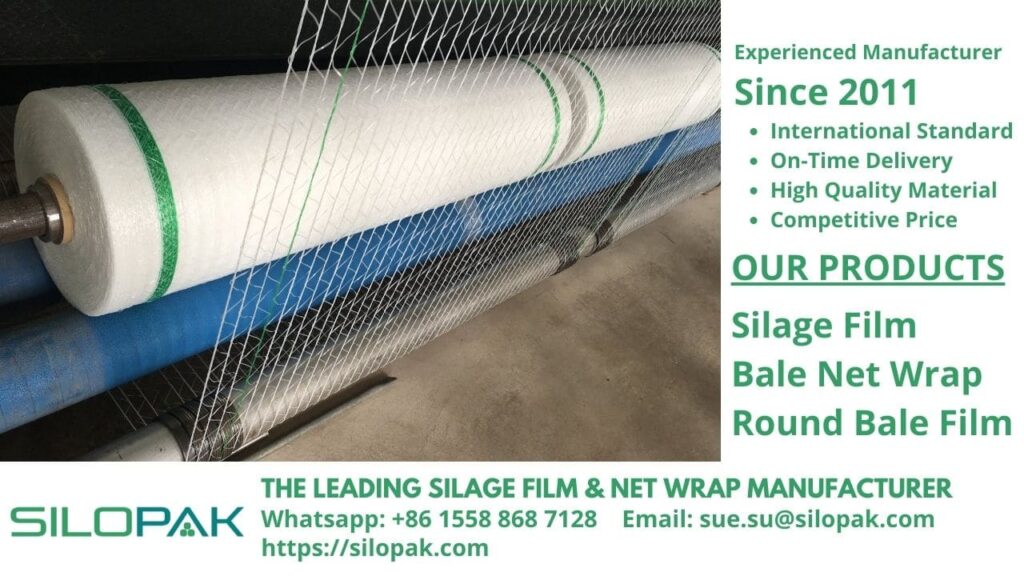
HDPE net wrap does not seal a bale airtight. It is an open mesh. Its job is to hold a bale in a compact, stable shape so it can be handled, stacked, and transported without falling apart, while allowing air to pass through.
This means HDPE wrap alone does not make silage. Silage preservation depends on excluding oxygen completely so that fermentation can occur, and an open mesh cannot do that. The airtight seal for silage comes from a different product: LLDPE silage stretch film. The two materials do different jobs.
| HDPE Net Wrap | LLDPE Silage Film | |
|---|---|---|
| Form | Open mesh, breathable | Solid, airtight, stretchable |
| Job | Holds bale shape | Excludes oxygen for fermentation |
| Use for | Dry hay, straw, and first layer under silage film | Silage and haylage |
So where does HDPE wrap fit? It is the right product for dry hay and straw, and it is the essential first layer on a round bale silage, applied to compact and hold the bale before the airtight film goes over it. Understood in its proper role, HDPE wrap is excellent. Asked to do the film’s job, it fails.
Why HDPE Is the Right Material for Net Wrap
With that clarified, HDPE has real properties that make it ideal for net wrap.
HDPE has a higher molecular density than other polyethylenes such as LDPE, and that density gives it distinct mechanical strengths: high tensile strength, rigidity, and durability. For a net that must withstand the tension of the baling process and the handling of heavy bales by tractor forks, that strength is exactly what is needed.
UV resistance
Bales stored outdoors face months of sun, and UV is what destroys unprotected plastic. Quality HDPE net wrap is produced with UV stabilizers formulated into the material, so it resists becoming brittle and breaking down through a storage season. Without adequate UV stabilization, wrap degrades, crumbles, and fails, exposing the bale it was meant to protect. UV resistance is not a bonus feature; for outdoor storage it is essential.
Does not absorb moisture
HDPE does not absorb water. The material itself stays intact and structurally sound even after prolonged exposure to rain and damp. This matters for a wrap that lives outdoors: it holds its strength rather than weakening when wet.
One point to keep clear, though: because net wrap is an open mesh, it does not waterproof the bale inside. HDPE resists water, but the mesh lets water through to the forage. Dry hay wrapped in net still needs dry, covered storage. The wrap holds the bale; it does not keep the rain off the hay.
Chemical resistance
HDPE resists a wide range of chemicals, so it does not react with or degrade against the substances it may encounter in agricultural use, and it is chemically stable in contact with feed.
“The single most common question we answer about HDPE wrap is whether it can be used to make silage on its own. It cannot, and it is worth being clear about that, because a farmer who wraps wet silage in net wrap expecting it to ferment will lose the bale. HDPE net wrap is superb at what it is for: holding hay bales and giving silage bales their structure. The oxygen seal is a separate job for silage film. Use each for what it does.
— Sue Su, Marketing Director of Silopak
How to Choose Good HDPE Net Wrap
If you have not bought net wrap before, a few criteria separate a product that performs from one that disappoints.
- It must last a full season. Wrap that degrades before the season is out is a false economy, costing you in replacement and in wasted feed. Look for a product built to hold up through the whole storage period.
- Virgin, UV-stabilized material. Virgin HDPE with proper UV stabilizers holds its strength and resists field degradation. Recycled or poorly stabilized material tears and crumbles.
- Correct width for your baler. The wrap must match your baler chamber so the net covers the full face of the bale, including the shoulders.
- Consistent knitting and tape strength. Even mesh with no weak points holds the bale reliably under tension.
A Note on Heat
HDPE has a defined heat tolerance, softening at around 120°C, which is far above anything a bale encounters in normal outdoor storage, even in the hottest climates. For agricultural use, HDPE’s heat resistance is more than adequate, and the practical heat concern for stored forage is not the wrap melting but the bale overheating internally if it was baled too wet. That is a moisture and fermentation issue, not a property of the wrap.
Remember to Remove It
One safety point that applies to all net wrap regardless of quality: it must be removed from the bale before feeding. HDPE does not digest in the rumen and accumulates there, potentially causing weight loss and, in severe cases, digestive blockage. Cut and pull the wrap off in one piece, and keep it out of the feeding area.
Silopak manufactures HDPE bale net wrap from virgin UV-stabilized material, with a 12-month UV guarantee, alongside LLDPE silage film for the airtight sealing that fermentation requires. For matching net wrap to your machine, see our guide on net wrap for round balers.
Frequently Asked Questions
Q: Can HDPE wrap be used to make silage?
Not on its own. HDPE net wrap is an open mesh that holds a bale in shape but allows air through, so it cannot create the oxygen-free environment silage fermentation requires. For silage, the airtight seal comes from LLDPE silage film. On a round bale silage, both are used together: HDPE net wrap first to compact and hold the bale, then several layers of LLDPE film over it to seal out oxygen. Using net wrap alone on wet silage will result in a spoiled bale.
Q: What is HDPE net wrap best used for?
Dry hay and straw, where its job is to hold the bale in a compact, handleable shape while allowing airflow, and as the essential first layer on round bale silage, applied before the airtight film. HDPE’s strength, UV resistance, and durability make it ideal for these roles. It is not designed to seal a bale airtight, so it is the wrong product if your goal is to ferment wet forage without an accompanying film.
Q: Does HDPE net wrap make a bale waterproof?
No. HDPE the material does not absorb water and stays structurally sound when wet, but net wrap is an open mesh, so water passes straight through it to the forage inside. Dry hay wrapped in net wrap still needs dry, covered storage to stay sound. The wrap holds the bale together and helps it shed some weather, but it does not seal water out. If you need a waterproof, airtight barrier, that is the role of silage film, not net wrap.
Q: Is HDPE net wrap heat resistant enough for hot climates?
Yes. HDPE softens at around 120°C, far above any temperature a bale reaches in outdoor storage, even in very hot regions. The wrap itself is not at risk from ambient heat. The real heat concern with stored forage is internal overheating of a bale that was baled too wet, which is a moisture and fermentation problem rather than anything to do with the wrap. Quality UV stabilization matters more than heat tolerance for net wrap performance in hot, sunny climates.
Reviewed by Sue Su, Marketing Director of Silopak, on 15 September 2026. This guide has been revised to correct the description of HDPE net wrap as an oxygen seal; airtight sealing for silage is the role of LLDPE film, not HDPE net wrap.