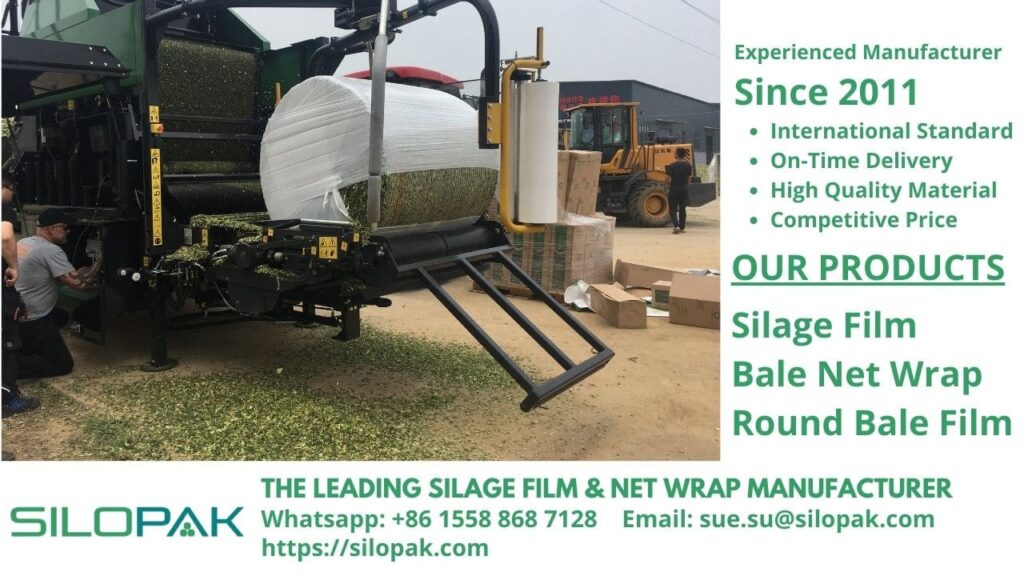
Making the bales is the easy part. Keeping them worth feeding six months later is where the money is won or lost. Crop baling film is what stands between the crop you harvested and the weather, the oxygen, and the pests that would otherwise degrade it.
But film is not the right answer for every bale, and using it on the wrong crop causes exactly the losses it is meant to prevent. This guide covers what crop baling film does, when to use it, and when to use something else instead.
Film or Net Wrap? Get This Right First
This is the single most important decision, and it is frequently confused.
| Crop Baling Film | Bale Net Wrap | |
|---|---|---|
| Structure | Solid, airtight, stretchable | Open mesh, breathable |
| What it does | Excludes oxygen completely, enabling fermentation | Holds the bale in shape through handling |
| Use for | Silage and haylage (50 to 70% moisture) | Dry hay and straw (14 to 18% moisture) |
| Preservation method | Anaerobic fermentation | Dryness |
| Used together? | Yes, for silage bales. Net wrap first to compact and hold the bale, then film over it to seal | |
The mistake that costs farms money
Sealing genuinely dry hay in airtight film sounds protective, and it is a trap. Hay always retains some residual moisture. In an airtight wrap with nowhere for that moisture to go, it condenses, and mould follows. In severe cases, damp hay sealed tight can heat to the point of spontaneous combustion.
Dry hay is preserved by being dry. It needs net wrap to hold its shape and dry, covered storage to keep the rain off. It does not need, and should not have, an airtight seal.
Film belongs on wet crops that are meant to ferment. That is what it is engineered for.
What Crop Baling Film Actually Does
It creates the oxygen barrier fermentation requires
This is the whole point. Silage preservation depends on lactic acid bacteria working in a completely oxygen-free environment. They ferment plant sugars into lactic acid, the pH drops, and spoilage organisms can no longer survive.
Oxygen ruins this at both ends. Before fermentation gets going, aerobic bacteria consume the very sugars the lactic acid bacteria need. After fermentation is complete, any oxygen entering through a puncture reactivates dormant yeasts and moulds, and the silage starts spoiling from the inside.
A film that holds its seal for the whole storage period is not a nice-to-have. It is the mechanism.
It protects against weather and pests
Bales stored outdoors face rain, UV, birds, and rodents. Rodents in particular will chew through inadequate wrap, and every hole they make is an oxygen entry point. A quality film resists tearing and puncture, and remains flexible rather than becoming brittle under months of sun exposure.
It makes bales manageable
Wrapped round bales roll and stack without shedding material everywhere. Unwrapped bales shed, tangle, and leave a mess of wasted forage across the yard. Square bales need equipment to move regardless, but wrapping still contains the material.
How Many Layers?
For fermented bales, layer count is not a detail. It is the seal.
Four to six layers is the standard range. Fewer layers means a thinner barrier with less tolerance for the inevitable small punctures that occur during handling and storage. Six layers is generally recommended for bales that will be stored a long time, handled repeatedly, transported, or kept in hot climates.
Skimping on layers to save film is a false economy. The cost of two extra layers is trivial against the value of the forage inside the bale.
Silopak Crop Baling Film Specifications
| Specification | Detail |
|---|---|
| Material | Virgin LLDPE (linear low-density polyethylene) |
| Sizes | 750mm x 1500m / 500mm x 1800m / 250mm x 1800m |
| Thickness | 25 microns |
| Colour | White (heat reflective, UV protective) |
| UV guarantee | 12 months against UV degradation |
| Usable storage life | 18 months or more with the seal intact |
| Key properties | High tear and puncture resistance, strong cling, all-weather durability |
Silopak has manufactured silage film and bale net wrap since 2011 from premium virgin resin, exporting to farms worldwide. For the baler and wrapper machinery itself, our group company Jummos produces the equipment.
Getting the Most From Your Film
- Wrap immediately after baling. Every hour a wet bale sits unwrapped, aerobic deterioration is under way and the sugars fermentation needs are being consumed.
- Store on a smooth surface. Stubble, stones, and debris puncture film from below. A flat, clear storage area prevents a large share of seal failures.
- Inspect regularly. Check bales through storage and patch any punctures promptly with proper repair tape. A small hole left unaddressed will spoil a whole bale.
- Control rodents. They are one of the most common causes of punctured film, and the damage is often invisible until the bale is opened.
- Remove all film before feeding. Plastic does not digest in the rumen and accumulates there. This applies to film and net wrap alike.
Frequently Asked Questions
Q: Can I wrap dry hay in silage film?
It is generally not advisable. Dry hay is preserved by being dry, and it always retains some residual moisture. Sealing it in an airtight film traps that moisture with nowhere to escape, which leads to mould and, in serious cases, heating severe enough to risk spontaneous combustion. Dry hay should be bound with net wrap to hold its shape and kept in dry, covered storage. Airtight film is designed for wet crops that are meant to ferment, which is a fundamentally different preservation mechanism.
Q: How many layers of film does a silage bale need?
Four to six layers is the standard range. Six layers is recommended for bales stored long term, handled repeatedly, transported, or kept in hot climates, where the seal faces more stress. The layers are what create and maintain the airtight barrier, and that barrier is the entire preservation mechanism. Using fewer layers to save on film risks losing the whole bale, which is a poor trade against the small cost of the extra film.
Q: What is the difference between crop baling film and net wrap?
Net wrap is an open mesh that holds a bale in shape but allows air through freely. Crop baling film is a solid, stretchable, airtight layer that excludes oxygen entirely. Net wrap is used for dry hay and straw, where airflow is harmless. Film is used for silage and haylage, where oxygen must be excluded so fermentation can preserve the crop. For silage bales, both are used together: net wrap first to compact and hold the bale, then film over it to create the seal.
Q: Why is silage film white?
White film reflects sunlight and heat, keeping the internal temperature of the bale stable through outdoor storage. Dark film absorbs heat, raising internal temperature, which increases nutrient loss and the risk of mould. White film also carries UV stabilizers that stop the plastic itself becoming brittle and cracking under prolonged sun exposure. Together these properties protect both the film and the fermentation inside it.
Reviewed by Sue Su, Marketing Director of Silopak, on 5 September 2026. This guide has been revised to clarify that airtight film is intended for fermented crops and should not be used to seal dry hay.