In feeding the livestock, the farmers need silage film thickness recommendations to maximize the budget and the result. The wrap is one of the important things that will keep the feed stuck together in one place/spot.
It supports the fermentation process and the storage. This kind of feed should be included in the livestock’s meal. The nutrition intake is required to grow well and reach the target. To make sure that the feedstock remains good during storage, they need the right layer of wrap. The following explanation will highlight the wrap thing.
Concerning the Wrap Gauge
To push up the profitability and productivity, any investment should be calculated to reach the goal and avoid profit loss. Is it wise and profitable to choose multilayer wrap? The oxygen needs to be blocked to avoid oxidation that leads to heat rise.
The UV light has a bad effect that the feed bales have to be protected from. The gauge affects the wrap performance to fight against the UV light effect and oxygen. The durability is also the one that is affected by the wrap gauge. There is a belief about this that the thicker, the better. That is traditional logic that can be both right and wrong, depending on the material.
Multilayer Popularity
Indeed, more layers for one bale are now hitting their popularity in silage film thickness recommendations. As the farmers face the challenge of new obstacles, the experts worked on the number of layers. The nightmare of this is the bulky bales that will affect the storage space. The experts also worked on a single thick material. However, the result shows that the multilayer innovation with thin material is better in performance.
The sealing is better with good flexibility. The flexibility is not about the stretchability of the material, but also the spot that it has to cover. If there is a spot that you think needs more layers to cover, you can. Also, when it gets broken or torn in the surface layer, the next layer still protects the feed. Meanwhile, the thicker one that consists of fewer layers is harder to do that. Once broken, it will be harder to repair.
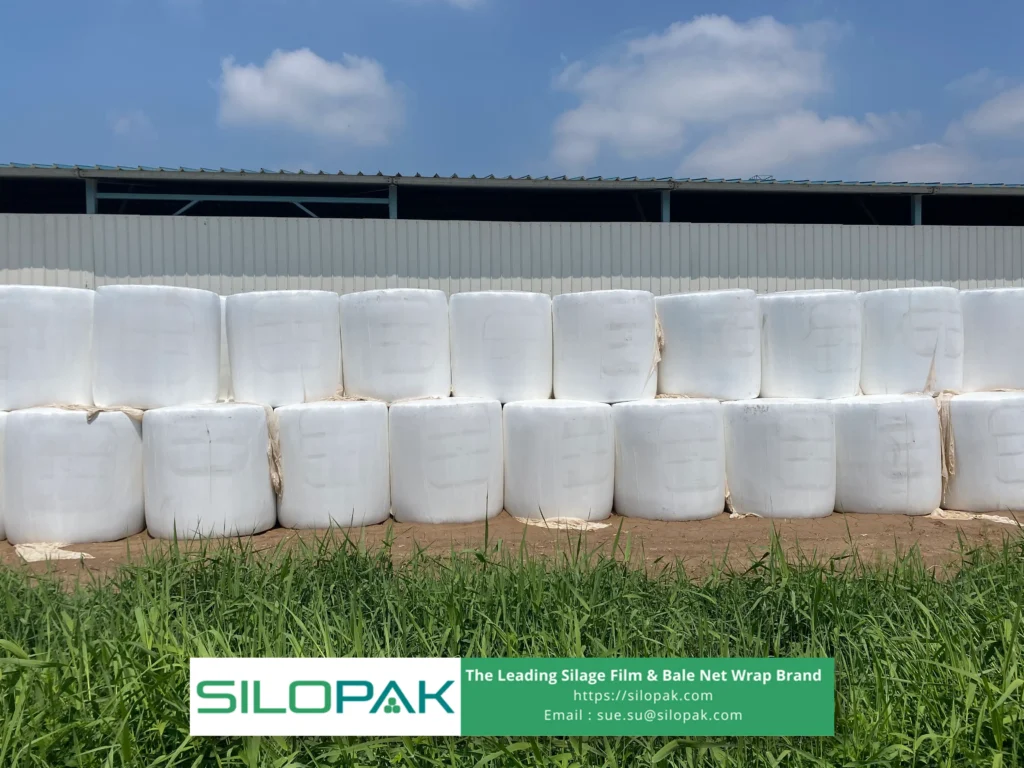
Silopak Multilayer Silage Film for Superior Feed Protection
Feed and Productivity
The right nutrient intake maintains the livestock’s health. Pregnant female livestock could have good nutrients for the fetus. The sick ones can recover faster. Health is an important key in husbandry because this business is related to living creatures.
The benefits of using the right wrap are that the fermentation process is faster, the spoilage can be avoided, and it lasts longer than if it’s wrapped with low-quality wraps. The other notable outcomes are good weight for cattle that are raised for meat and abundant milk for dairy cows. Recent research on this topic shows agreement on the causality connection between the wrap and the product quality.
Let’s Calculate!
To state and decide whether this is one of the profitable silage film thickness recommendations, calculating the whole thing thoroughly is needed.
- The price: The price of high-tech multilayer wrap is more expensive than the standard one. However, the next explanation will give the details on whether the price gives a higher value with more profit or not.
- Feed waste: The high-tech multilayer can reduce feed waste. The waste is only 2-4%. Meanwhile, the standard one wastes 5-10%. If this percentage is applied to the real calculation, it will be like: for every 500 tons, standard film waste 25 to 50 tons, the high-tech Multilayer waste 10 to 20 tons. The high-tech could save 15 to 30 tons. This amount is enough to feed the livestock for one month (assuming that 500 tons is for a year’s feeding).
- Dry matter loss: The standard wrap loss is 8 to 15%, meanwhile the high-tech multilayer loss is 3 to 8%. The standard one even puts the maximum loss percentage of the multilayer one as the starting point.
Based on this calculation, the price gap is well worth it with less dry matter loss and feed waste reduction. However, it is not the final decision. It also doesn’t mean that the standard one is that bad.
Suggestion According to the Condition
In the end, both monolayer and multi-layer can be right according to the condition.
- Thinner multi-layers: For a limited storage duration, the high-quality feed can be wrapped with multi-layers.
- Thicker monolayer: Otherwise, for longer storage duration, a thicker monolayer is suggested. This also works to fight against extreme climate change.
There is no single choice that works for all conditions. The silver lining is that the innovation or new solution might be more important than the traditional logic (the thicker is the better). The condition and the storage techniques also have to be considered.
Sometimes, thinner but multi-layered is profitable and better. The farmers should pay attention to what they need to combine with the latest technology. Then, examine and evaluate silage film thickness recommendations related to the real application so that the profit will not decrease and the business can last long.