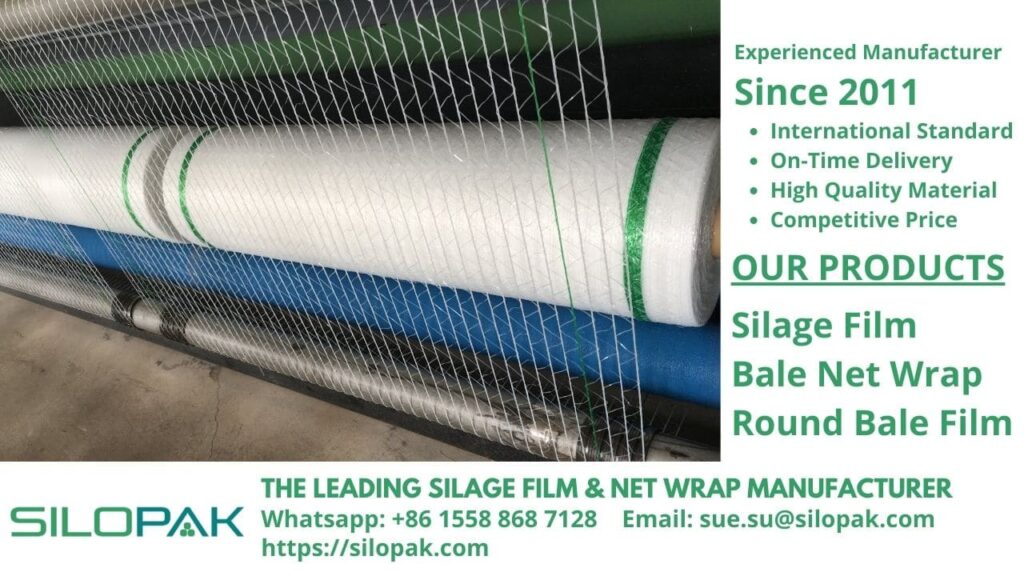
Bale net wrap has transformed forage handling in Argentina and across South America. It binds bales faster than twine, cuts harvest and storage losses, and reduces the labour needed to keep livestock fed. Those benefits are real and they are why net wrap has become the dominant binding method on most operations.
There is a serious problem that comes with it, though, and as a manufacturer we would rather state it plainly than leave farmers to discover it the hard way.
Net Wrap Does Not Break Down Inside Cattle
Net wrap is plastic. If cattle eat it, whether by accident, through boredom, or because it was left on a bale that got ground into a ration, it does not pass through and it does not digest. It stays.
Research from North Dakota State University placed net wrap in the rumen for 14 days. The hay sample was almost entirely digested. Sisal twine was more than 70% gone. The net wrap had not diminished at all. Not partially. Not slowly. It simply did not break down.
The consequences accumulate. A study at South Dakota State University fed cows ground, net-wrapped hay for 140 days. Those cows developed a softball-sized mass in the rumen containing roughly 0.8 to 1.1 pounds of net wrap, which measured around three feet when stretched out. Approximately 53% of the net wrap fed was recovered from the rumen. Montana State University found a similar figure, recovering 47% of the net wrap offered from the digestive tract.
A separate Montana State report found that of the net wrap retained in the digestive tract, 99.9% sat in the reticulorumen. It goes in and it stays where it lands.
What This Does to the Animal
The accumulated mass reduces functional rumen capacity. The animal feels full, eats less, and loses condition despite feed being available. Symptoms include weight loss, diarrhea, and a general wasting presentation that can resemble hardware disease or Johne’s disease, which is part of why the cause is so often missed.
Left to build up over seasons, the mass can block the digestive tract entirely. Researchers have documented cases of cattle wasting away to the point of needing to be euthanised, with net wrap found in the rumen at necropsy.
This is not a theoretical risk. It is a documented, repeatable outcome of feeding net-wrapped bales without removing the wrap.
“We manufacture net wrap, and we will tell any customer the same thing: it has to come off before the bale is fed. There is no grade of net wrap, ours included, that is safe for cattle to eat. Virgin resin gives you strength, UV life, and consistency. It does not make plastic digestible. Anyone who tells you their net wrap is safe to leave on at feeding is either mistaken or selling you something.”
— Sue Su, Marketing Director of Silopak
Grinding Is Where Most of the Damage Happens
Here is the pattern that causes the most harm.
A South Dakota State survey found that 54% of producers remove net wrap when feeding bales whole, but only 11% remove it when grinding bales. The reasoning is understandable: the grinder will chop it up anyway, and removing wrap from every bale before it goes into the machine costs real time.
But grinding does not solve the problem, it disguises it. Chopping net wrap into small fragments makes it easier for cattle to consume without noticing, and those fragments still cannot be digested. They simply accumulate more insidiously.
If you grind, the wrap must come off first. There is no shortcut here.
Biodegradable Twine Is Not a Solution Either
This one catches people out, and it is worth being explicit about.
Biodegradable twine degrades under UV light. There is no UV light inside a rumen. NDSU research found biodegradable twine, like net wrap, did not break down in the rumen at all over 14 days.
Sisal twine is genuinely different. It is a natural fibre and rumen microbes do digest it, with more than 70% disappearing over 14 days in the same study. If binding material is going to end up in the feed regardless, sisal is the only option that the animal can actually process. That does not make it a licence to leave it on, but it is a meaningful distinction.
| Binding Material | Digested in the Rumen? | Must Be Removed? |
|---|---|---|
| Plastic net wrap | No. Does not diminish at all | Yes, always |
| Polypropylene twine | No | Yes, always |
| “Biodegradable” twine | No. It needs UV light, which the rumen does not have | Yes, always |
| Sisal twine | Yes. Over 70% digested in 14 days | Still best removed, but far lower risk |
Practical Steps
- Remove net wrap from every bale before feeding. Whole bale or ground, no exception.
- Cut and pull, do not tear. Tearing leaves fragments behind. Cut the wrap cleanly and pull it off intact so it comes away in one piece.
- Collect the removed wrap immediately. Wrap left lying in the feeding area gets eaten out of boredom.
- Watch for the symptoms. Unexplained weight loss, reduced intake, and diarrhea in cattle that have been fed wrapped bales are worth investigating with a vet, particularly if the wrap has not been reliably removed.
- Build removal into the routine. The reason wrap gets left on is that removal is an extra step under time pressure. Make it part of the process rather than an optional extra.
Where Quality Net Wrap Does Matter
To be clear about what quality does and does not do.
A good net wrap will not tear during handling, will not shed fragments when you pull it off, will hold the bale securely through storage and transport, and will survive UV exposure without becoming brittle. A poor net wrap tears, disintegrates, and leaves pieces behind in the feeding area, which is precisely how fragments end up being eaten.
So quality genuinely reduces risk, but by keeping the wrap intact and removable, not by being safe to consume.
Silopak has manufactured bale net wrap since 2011 from 100% virgin UV-stabilized HDPE, exporting to Argentina, Chile, Brazil, Mexico, and markets worldwide. Our net wrap is strong, UV stable, and comes off cleanly. It is not, and cannot be, safe for cattle to eat, and neither is anyone else’s.
Frequently Asked Questions
Q: Does net wrap break down in a cow’s stomach?
No. Research from North Dakota State University placed net wrap in the rumen for 14 days and found it had not diminished at all, while hay was almost fully digested in the same period. Studies at South Dakota State and Montana State recovered roughly 47 to 53% of the net wrap fed, and one report found 99.9% of the retained material sitting in the reticulorumen. Net wrap does not digest and largely does not pass through. It accumulates.
Q: Is it safe to grind bales without removing the net wrap?
No, and this is the most common way the problem arises. A survey found only 11% of producers remove net wrap before grinding, compared with 54% who remove it when feeding whole bales. Grinding does not eliminate the plastic, it just reduces it to fragments that cattle consume more readily without noticing. Those fragments still cannot be digested and still accumulate in the rumen. The wrap must be removed before the bale goes into the grinder.
Q: Is biodegradable twine safe if cattle eat it?
No. Biodegradable twine degrades under UV light, and there is no UV light inside the rumen. Research found it did not break down in the rumen any more than plastic net wrap did. Sisal twine is the genuine exception, being a natural fibre that rumen microbes digest, with over 70% breaking down in 14 days. But biodegradable plastic twine should be treated exactly like conventional plastic: remove it before feeding.
Q: What are the symptoms of net wrap accumulation in cattle?
Gradual weight loss despite adequate feed, reduced intake, and diarrhea are the common signs, caused by the accumulated mass occupying rumen capacity and in severe cases blocking the digestive tract. The presentation resembles hardware disease or Johne’s disease, which is one reason it is often misdiagnosed. If cattle that have been fed wrapped bales are wasting without clear cause, discuss net wrap ingestion with your veterinarian as a possibility.
Reviewed by Sue Su, Marketing Director of Silopak, on 30 August 2026. This guide has been revised to reflect published research from North Dakota State, South Dakota State, and Montana State universities on net wrap retention in the rumen.