Livestock operations that run at high mechanization and larger scale depend on knot-strength twine as a frontline solution against bale failure. When the binding system does not run smoothly, several things are immediately at stake: animal safety, labor efficiency, and the availability of feed are the first sectors affected. This article explains how twine performance contributes to failure prevention, and why the right twine is a risk-management decision rather than a simple consumable purchase.
Why Bale Failure Matters in Large-Scale Operations
The first thing to understand is that buying twine is an investment, not a throwaway cost. When calculating the total cost of a baling operation, twine should not be filed under consumables that bring no return. Its role is to change the outcome of the entire process. To see why, consider the main causes of bale failure.
| Failure Type | Description | Common Causes |
|---|---|---|
| Bale tie slippage | The tie does not grip itself strongly and slips loose | Incompatible twine type, wrong tying technique, slippery material |
| Material fatigue | Twine quality degrades over time and loses strength | Repeated stress, UV exposure, humidity, prolonged storage |
| Tension inconsistency | Uneven tight and loose sections weaken the bale | Inconsistent application, worn baler tension components |
On a small scale, a single failure may be a minor inconvenience. In high-throughput feeding operations, however, the same failure is amplified for several reasons.
- Fast operation. The process runs quickly, so a small mistake can compound before the root cause is detected. Often a problem is only noticed after it has already triggered a larger one, making it harder to correct.
- Greater mechanical load. Large-scale work pushes machinery harder, and a single recurring fault is multiplied across hundreds or thousands of bales.
- Low tolerance for error. Systems built around efficiency are excellent at managing time and cost but are not flexible toward small failures. One small fault can disrupt the entire feeding flow.
- Domino effect. A failure in one section can stall or ruin the next phase, and the cumulative loss becomes significant.
- Long operating hours. Machines running for extended shifts are more prone to being overwhelmed, which compounds the impact of any binding weakness.
Every single tie carries a share of the burden that determines whether the system succeeds. A small failure at the binding point can cost a disproportionate amount.
How Knot-Strength Twine Helps
Knot-strength twine holds its load securely while in the tied condition. This reflects the real performance of the twine in the field, which is different from tensile strength. Tensile strength measures the maximum load the twine can carry in a straight, untied condition, representing the material at its theoretical best. Knot strength measures performance where it actually matters: at the knot.
The tie is the weakest point of any binding for several reasons. The knot creates sharp curves where flexibility differs from the rest of the twine. There is extra tension concentrated at that point. The multiple layers of twine in the knot press against each other, creating unavoidable abrasion and friction. This results in localized structural stress, heat, and micro-tears. In short, the knot is weak because of overload, uneven compression, and bent fibers all occurring in one small zone.
Under these conditions, the twine is expected to remain strong enough to maintain binding integrity. It must resist stress concentration, hold the binding stable under heavy load, and keep performance consistent even where compression is uneven. This is exactly what knot-strength twine is engineered to do.
Silopak Baler Twine Specifications
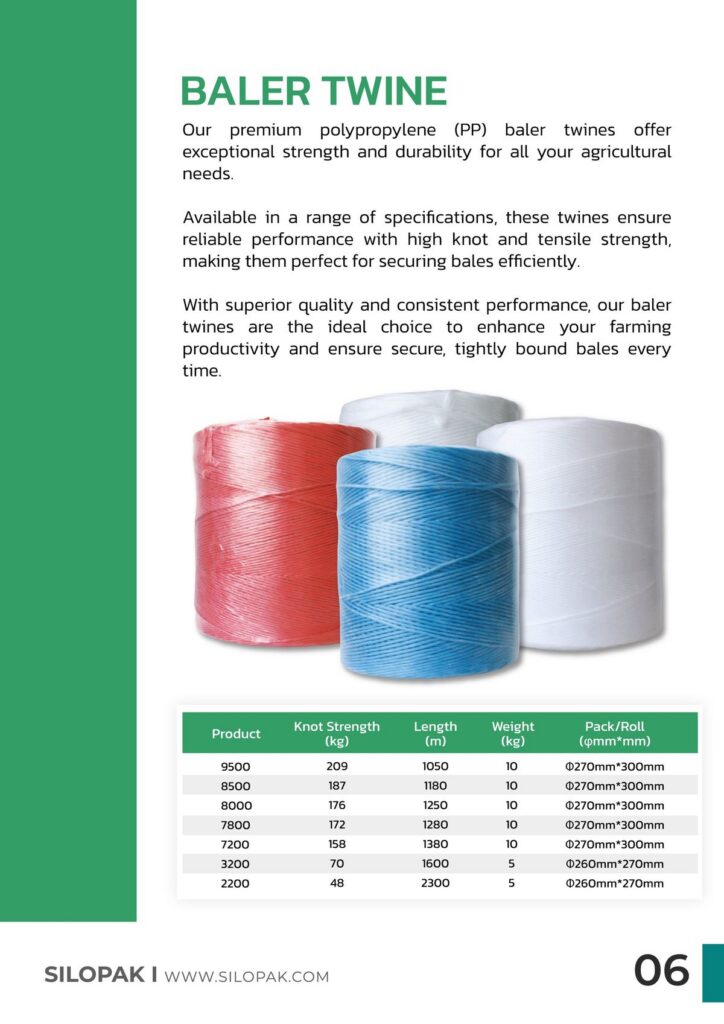
Silopak produces premium polypropylene (PP) baler twine engineered for high knot and tensile strength, suitable for a full range of agricultural baling needs. The range covers heavy-duty high-knot-strength options through to lighter, longer-length options, allowing operators to match the twine to their machine and bale density requirements.
| Product | Knot Strength (kg) | Length (m) | Weight (kg) | Pack/Roll (mm) |
|---|---|---|---|---|
| 9500 | 209 | 1050 | 10 | 270mm x 300mm |
| 8500 | 187 | 1180 | 10 | 270mm x 300mm |
| 8000 | 176 | 1250 | 10 | 270mm x 300mm |
| 7800 | 172 | 1280 | 10 | 270mm x 300mm |
| 7200 | 158 | 1380 | 10 | 270mm x 300mm |
| 3200 | 70 | 1600 | 5 | 260mm x 270mm |
| 2200 | 48 | 2300 | 5 | 260mm x 270mm |
The higher-numbered products such as the 9500 and 8500 deliver the greatest knot strength, suited to dense, heavy bales and demanding high-throughput operations. The lighter 3200 and 2200 options offer greater length per roll for lower-density baling where maximum knot strength is less critical. Matching the product to your bale density and machine is the foundation of reliable binding.
“Operators sometimes focus only on tensile strength when choosing twine, but in the field it is knot strength that determines whether a bale holds. The knot is always the weakest point, so a twine rated for high knot strength is what actually prevents bale failure under load. For high-throughput operations, choosing the right knot-strength rating for your bale density is one of the simplest and most effective risk controls available.”
— Sue Su, Marketing Director of Silopak
Twine as an Effective Risk Management Strategy
Risk management does not always concern the whole large system. Sometimes a small component, such as the knot-strength twine, plays a disproportionately large role. Twine selection is a preventive control against failure. As established above, small failures lead to bigger ones, so addressing the binding point addresses the root.
Consistent binding integrity maintains bale stability throughout the entire process. When bales remain stable, there are no sudden failures. Downstream disruptions can be avoided, including operator safety hazards, product loss, machinery stoppages, and blockages in the feeding process. This is the foundation of business continuity, where operational activity is reliably guaranteed.
When this small component is in ideal condition, both in material and in the way it is applied, the system runs without repetitive intervention. Output variability, additional maintenance cost, feed loss, and unplanned downtime all decrease significantly. This is one of the most cost-effective risk management techniques available, because it stops the domino effect at its source by focusing on a micro performance factor that affects macro performance.
The Financial Case for Quality Twine
From a financial perspective, choosing quality knot-strength twine functions as cost stabilization. Selecting better material with verified knot strength overcomes hidden expenses such as feed waste, downtime, and extra labor, and it reduces total operational cost over the season. The small premium paid for a higher-rated twine is repaid many times over by the failures it prevents.
| Hidden Cost of Twine Failure | How Quality Knot-Strength Twine Prevents It |
|---|---|
| Feed loss from failed bales | Stable binding keeps forage contained and usable |
| Machinery downtime | Fewer jams and stoppages from slipped or broken ties |
| Extra labor for rework | Bales hold first time, eliminating re-tying and clean-up |
| Operator safety incidents | Stable bales reduce handling hazards during transport and stacking |
| Output variability | Consistent binding produces uniform, predictable bales |
Knot-strength twine is a key element in bale failure risk management. It focuses on the micro performance that affects the macro outcome of the entire operation, making it one of the most efficient investments a large-scale livestock business can make.
Frequently Asked Questions about Knot-Strength Baler Twine
Q: What is the difference between knot strength and tensile strength in baler twine?
Tensile strength measures the maximum load the twine can hold in a straight line without a knot, representing the material at its theoretical maximum. Knot strength measures how much load the twine holds while tied in a knot, which is how twine is actually used in the field. Knot strength is always lower than tensile strength because the knot is the weakest point, where sharp curves, concentrated tension, and friction between layers reduce the effective strength. When choosing baler twine, knot strength is the more practically meaningful figure because bale failure almost always occurs at the knot, not along the straight length of twine.
Q: Which Silopak twine has the highest knot strength?
The Silopak 9500 product has the highest knot strength in the range at 209 kg, with a length of 1050 m per 10 kg roll. It is followed by the 8500 at 187 kg and the 8000 at 176 kg. These higher-strength products are designed for dense, heavy bales and demanding high-throughput operations where binding failure carries the greatest cost. The lighter 3200 (70 kg) and 2200 (48 kg) options offer longer length per roll and suit lower-density baling where maximum knot strength is less critical.
Q: How do I choose the right twine for my baler and bale density?
Match the knot strength rating to your bale density and the demands of your operation. Dense, heavy bales and high-throughput systems require high knot strength such as the 9500 or 8500 to prevent failure under load. Lighter, lower-density bales can use the 3200 or 2200, which provide more length per roll for greater efficiency where extreme knot strength is not needed. Also confirm that the twine specification is compatible with your specific baler model. If unsure, provide your baler details and typical bale density to the supplier for a specific recommendation.
Q: What causes baler twine to fail at the knot?
Twine fails at the knot because that point experiences the highest concentration of stress in the entire binding. The knot creates sharp bends in the fiber, concentrates tension in a small zone, and forces multiple layers of twine to press and rub against each other, generating friction, localized heat, and micro-tears. Over time, factors such as UV exposure, humidity, and repeated load cycling accelerate this degradation. Choosing a twine engineered specifically for high knot strength, and applying it with consistent tension and correct tying technique, addresses the root of most knot failures.
Q: What material is Silopak baler twine made from?
Silopak baler twine is made from premium polypropylene (PP), a synthetic material chosen for its combination of strength, durability, and resistance to environmental degradation. Polypropylene twine offers reliable performance with high knot and tensile strength, making it well suited to securing bales efficiently across a range of agricultural conditions. The material also resists moisture, which helps maintain binding integrity during outdoor storage and handling.
Q: Is investing in higher knot-strength twine worth the extra cost?
For large-scale and high-throughput operations, yes. The price difference between standard and high knot-strength twine is small relative to the cost of the failures it prevents. A single bale failure in a high-throughput system can trigger feed loss, machinery downtime, rework labor, and even safety incidents, and these costs compound across a season. Quality knot-strength twine functions as cost stabilization, repaying its small premium many times over by preventing the cascade of downstream losses that follow a binding failure. For small, low-volume operations the calculation is closer, but for any operation where bale failure has knock-on consequences, the higher-rated twine is a sound investment.
This article was last reviewed and updated by the Silopak Editorial Team on June18, 2026. Our team periodically revisits published content to ensure accuracy, relevance, and alignment with current best practices in livestock feed management and silage preservation.