Silage wrapping machinery has a big responsibility in the feed preservation process. In the husbandry world in general, it is the cornerstone of the whole system. The animals need feed as a nutrition provider that becomes the power to produce their products (meat or dairy products). This circle must be maintained well, don’t let one of the elements fall. Additionally, cost is also in that circle that powers the whole activities. Here is how to make the cycle keep turning.
Evolution of the Role
The viability of the cycle requires the farmers to work extra to manage the cost, monitor the operator’s skill, and adjust the machine settings to be efficient while maintaining environmental sustainability. Technology is growing fast to solve any problem. Before the technology that we see now, the tools were manual.
With the high demand, they had to switch to automatic. It is faster in production and more efficient in labour fees. Besides the improved production speed, the quality is higher. Related to waste and spoilage, recent technology also reduces that. The previous role that the tool was just a small part of has evolved to become the main core of the industry. It determines productivity, quality and saves labour fees.
When the old technology didn’t concern itself with labour safety, it is now more sophisticated in that regard. The recent phenomenon that is faced by most farmers is that the changing climate and economy affect the tools they choose.
Example: Modern Combi Bale Wrapping Machinery
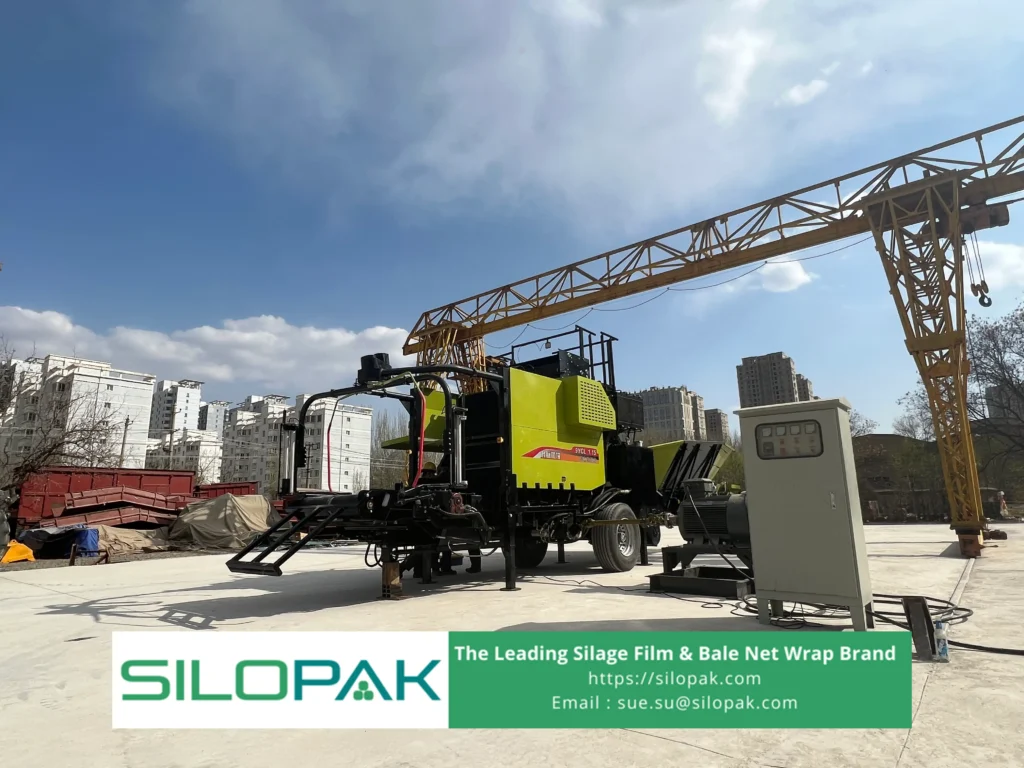
To better understand how modern silage wrapping machinery supports efficiency and feed preservation, consider a typical combi bale wrapper such as the 9YCL-0.63 COMBI BALE WRAPPER.
This type of machine integrates baling and wrapping into a single workflow, allowing continuous operation with a production capacity of 55–65 bales per hour. Equipped with dual film holders and a spiral arm wrapping mechanism, it ensures consistent overlap and tension, reducing air penetration and spoilage risk.
With a bale density of 650–800 kg/m³ and controlled wrapping parameters, machines like this demonstrate how technology directly influences feed quality, labor efficiency, and material usage.
Extra Training and Routine Service of Silage Wrapping Machinery
Operator training is often underestimated and viewed as an unnecessary expense. However, many costly feed losses are caused by operational errors such as incorrect wrapping speed, improper film tension, or inconsistent film overlap. These mistakes allow air to penetrate the bale, leading to mold growth and significant spoilage.
The other thing that’s related to film makes each bale use too many layers, which means wasting budget. Based on the importance that has been mentioned in the previous section, the program to improve the operator skill is a big investment.
Constant maintenance on the tools also boosts the performance. Usually, service or maintenance was made after recognising unusual behaviour of the tools. This way is not effective because the service itself needs time. If it is done after knowing the damage, there will be a lack of production activity. Besides, constant service can prevent the tools from bigger damage. Spending the budget on routine service is totally worth it.
Some cases prove that the training has good effects in spoilage reduction. The enclosure will be more proper if the bale is well wrapped. The consistency is levelled up, reducing the use of excessive film. The density and the tension are maintained so that air is hard to penetrate the compressed feed. That is why the spoilage percentage is reduced significantly.
The improved skill still can’t prevent some human errors. Smart technology is needed to make the system make zero mistakes. Automatic systems and sensors are two things to reach that level.
Sustainability Responsibility
In this era where pollution occurs in almost all elements (air, water, soil), having more environmentally friendly materials is primary. Single-use plastic is not recommended because it leaves a pile of trash that is hard to decompose.
Governments and organizations like the FAO are implementing policies and guidelines to reduce plastic pollution in agriculture, encouraging better waste management and material innovation.
-
The use of recyclable and biodegradable materials is increasingly recommended and, in some regions, supported by regulations to promote sustainability.
-
Change the settings of the machine to be more effective. The proper layer and the tension help to maximise the effectiveness of every inch of the film. The result is no excessive use.
- The farmers should be more educated in this field and more cooperative. Without it, any innovation or solution will be in vain.
Those are the important steps that have to be done, not to give profit to a particular party but for the common good. If we successfully reduce the waste footprint, the environmental condition will be better.
Balancing
Among a lot of efficiency methods, concern in silage wrapping machinery is the most economical. Changing the setting makes the film more efficient. The ROI (Return On Investment) of this is the highest calculated long-term operation. It concerns the basic needs of the livestock (feed), which also deals with the animal performance.
However, the sophisticated method has to be adjusted to the sustainability goal. Sustainability, efficiency and cost have to be balanced.
- Change the mindset to use biodegradable ones as the primary material.
- Use the right setting for each crop type.
- Upgrade the tools to be able to deal with biodegradable or recyclable films.
- Upgrade the operator skill/certification regularly. If there is an innovation in the technology, your operator will be the first to know.
Finally, efficiency is a collective work. Good tools will not be good without a skilled operator. And it has to be completed with sustainable materials to reach the sustainability goal. With the great combination, silage wrapping machinery works at its best.

Content last reviewed on 19 December 2025.