Farm animals are raised for a purpose: meat, milk, eggs, honey, wool, hides, or draft power from working animals like horses and mules. Livestock farming is a substantial and, done well, profitable business, and one of the oldest respected trades there is. But it does not run on animals and land alone. The right equipment determines how efficiently the farm operates, how healthy the animals stay, and how much of your time is spent on labour that a machine could do better. This guide covers the equipment a working livestock farm needs, from feeding through to handling, and why each piece earns its place.
Equipment for Raising Farm Animals
Before buying anything, be clear about what you are raising and at what scale, because that drives every equipment decision. A smallholder with a dozen animals and a commercial operation with several hundred need different tools, but the categories are the same: feeding, water, handling and restraint, transport, shelter, waste management, and animal health. The sections below work through each.
1. Feeding Equipment
Feeding is where most of the daily labour on a livestock farm goes, so it is where good equipment pays back fastest.
Feed mixer
A feed mixer, often a mixer wagon, shreds and blends different feed components into a uniform ration. The goal is a consistent mix that animals cannot sort through to pick out only the parts they like, which both improves nutrition and reduces waste. Many mixers accept whole bales without pre-cutting, which saves considerable time at feeding.
A total mixed ration, produced by a mixer, is particularly valuable for cattle fed a combination of forage and concentrates, because it ensures every mouthful has the same balance of nutrients. Note that not every operation needs one: pigs and poultry are typically fed formulated rations rather than mixed forage, so a forage mixer is mainly a ruminant tool.
Feeders and troughs
Feeders keep feed off the ground, which cuts waste and reduces contamination and disease spread. The right design depends on the animal and the feed: hay racks and ring feeders for round bales, trough feeders for concentrates and mixed rations, and creep feeders that let young stock access feed while excluding adults.
Hay, silage, and the wrapping that protects them
Hay is the traditional way to conserve forage, preserved by drying: the faster the cut grass dries to a safe moisture, the better the hay. It needs turning to dry evenly, then baling and dry storage. Silage is the alternative for wetter conditions, preserving forage through airtight fermentation rather than drying.
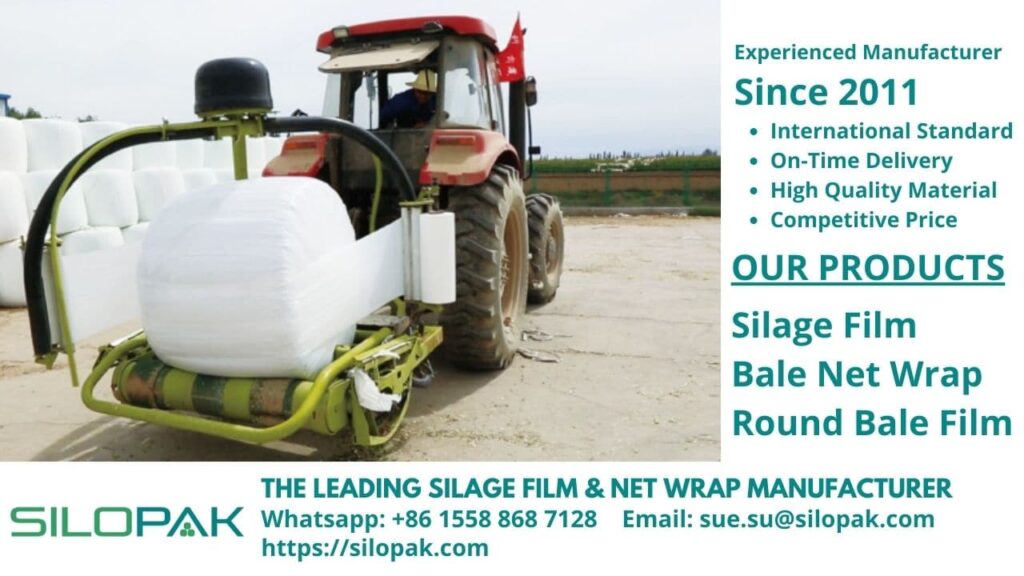
Both depend on quality wrapping to hold their value. The baling process uses bale net wrap or twine for dry hay, and silage film for fermented bales. Silopak manufactures net wrap, silage film, and round bale film from premium virgin resin, built to hold up through more than eighteen months of storage under real weather. Getting the wrapping right is not a side detail; it is what determines whether the feed you harvested is still feed months later.
“Farmers invest heavily in feed mixers and handling equipment, then sometimes economize on the wrap, which is the one thing standing between the harvested crop and spoilage. We see the consequences: excellent feed lost over winter because a cheap wrap failed. The wrapping is a small part of the equipment budget and it protects the largest part of the feed investment. It deserves the same care as the machinery.”
— Sue Su, Marketing Director of Silopak
2. Water Supply Equipment
Water is the most important nutrient and the one most often under-planned. A large farm needs large, reliable water capacity, which usually means storage tanks plus a distribution system of troughs or automatic waterers.
Waterers are typically basins of galvanized steel, concrete, or heavy rubber. Keep them full and clean, since fouled water depresses intake and spreads disease, and intake drives feed intake and therefore performance.
Water source matters, and this is worth getting right. Clean, tested groundwater from a drilled well is one of the best and most reliable water sources for livestock. What to avoid is stagnant surface water, ponds, and standing pools, which harbour bacteria, parasites, and toxins such as blue-green algae. If in doubt, test the water: it should be safe to drink before it goes to animals.
Automatic waterers
Automatic waterers refill themselves to a set level, cutting the daily labour of filling troughs and ensuring water is always available. In cold climates, heated versions prevent freezing, which is a genuine risk: cattle that cannot drink because the trough is iced over will cut their feed intake sharply.
3. Handling and Restraint Equipment
Safe handling protects both the animal and the handler, and it is where injuries most often happen when equipment is inadequate.
Headgate and squeeze chute
A headgate holds an animal’s head in place for examination, treatment, or feeding. A good headgate is safe, sturdy, simple to operate, and quiet, since clanging and banging stress the animal and make handling harder. For cattle, a headgate is usually part of a squeeze chute, which restrains the whole body so procedures like vaccination, tagging, or veterinary treatment can be done safely.
Race and pen systems
A handling system channels animals from a holding pen through a narrowing race into the chute. Well-designed systems use the animals’ natural behaviour, curved races and solid sides that prevent them seeing distractions, to keep them moving calmly. Adjustable alleys, gates, and panels let one system serve different jobs and group sizes. Portable pen and panel systems can be set up in the field, under a tree for shade, or on pasture, giving flexibility without permanent infrastructure.
4. Fencing
Fencing is fundamental equipment that the original discussion of farm tools often skips, yet it defines the entire operation. It keeps stock in, keeps predators out, and, through subdivision, makes rotational grazing possible.
The main types each suit different situations:
- Permanent fencing (post and wire, or post and rail) for boundaries and long-term paddocks.
- Electric fencing, permanent or portable, as a cost-effective and flexible barrier, ideal for subdividing pasture for rotational grazing.
- Temporary fencing (portable posts and polywire) for strip grazing and short-term needs.
Rotational grazing, made possible by subdividing pasture, is one of the most effective ways to improve pasture productivity and animal performance, and it depends entirely on having flexible fencing to work with.
5. Transport: The Livestock Trailer
A livestock trailer transports cattle, sheep, or horses, and owning one saves the recurring cost of hiring transport every time animals need to move. Beyond moving stock to market, breeding, or new pasture, a trailer carries feed, timber, and firewood, and it is invaluable in an emergency, whether moving animals away from danger or taking one to a veterinarian.
Choose a trailer sized and specified for your animals: adequate ventilation, non-slip flooring, and secure partitioning all matter for animal welfare during transport, and a stressed or injured animal in transit is both a welfare and a financial loss.
6. Shelter and Housing
Animals need protection from extremes of weather, heat and sun as much as cold and rain. Shelter requirements vary enormously by climate and species, but the categories are consistent:
- Field shelters, simple three-sided structures giving shade and windbreak on pasture.
- Barns and sheds for housing, calving or lambing, and winter shelter in cold climates.
- Shade structures, which are critical in hot climates, where heat stress cuts production and can kill.
Good housing also makes other tasks easier: sick animals can be isolated, young stock protected, and feeding and handling carried out under cover in bad weather.
7. Waste Management
Manure accumulates fast, and managing it is both a practical necessity and an opportunity.
A manure spreader, towed by tractor or ATV, distributes accumulated manure thinly across the land, where it becomes fertilizer that improves soil fertility. Spreading it thinly rather than leaving it in piles also reduces contaminated runoff and cuts fly populations, which improves animal health. For operations where stock are housed regularly and also grazed, a spreader is close to essential.
Handled well, manure is not waste but a resource that closes the loop between animal and pasture, returning nutrients to the ground that grows the next season’s feed.
8. Animal Health and Identification
A category the original equipment lists often omit, but no working farm functions without it.
- Identification, ear tags, and increasingly electronic ID, to track individual animals for health, breeding, and regulatory records.
- Basic veterinary equipment, syringes, drenching guns, and a secure medicine store with refrigeration for products that require it.
- Hoof care tools for trimming and treating feet, since lameness is one of the most common and costly welfare problems in cattle and sheep.
- Weighing equipment, since matching feed and treatment to actual body weight, rather than guessing, improves both outcomes and cost control.
Prioritizing Your Equipment Investment
You do not need everything on day one. A sensible order of priority for a new operation:
| Priority | Equipment | Why |
|---|---|---|
| Essential from day one | Fencing, water supply, basic shelter, feeders | Animals cannot be kept safely or healthily without these |
| Early priority | Handling system and headgate, identification, basic vet kit | Needed for safe routine care and treatment |
| As the operation grows | Feed mixer, livestock trailer, manure spreader | Labour-saving equipment that pays back at scale |
| Ongoing consumables | Bale net wrap, silage film, twine | Recurring cost that protects the feed investment every season |
Match the equipment to your scale rather than buying everything at once. A feed mixer that suits a large dairy is an unnecessary expense for a smallholding, while fencing and water are non-negotiable at any size. And where an existing tool still does the job, replacing it just because a newer model exists is cost without return.
Frequently Asked Questions
Q: What is the most essential equipment for starting a livestock farm?
Fencing, a reliable water supply, basic shelter, and feeders come first, because animals cannot be kept safely or healthily without them. A handling system with a headgate follows closely, since safe routine care and treatment depend on being able to restrain animals properly. Labour-saving machinery like feed mixers, trailers, and manure spreaders is worth investing in as the operation grows and the labour they save justifies the cost. Match the equipment to your scale rather than buying everything at once.
Q: Do all livestock farms need a feed mixer?
No. A feed mixer is most valuable for ruminants such as cattle fed a total mixed ration combining forage and concentrates, where it ensures consistent nutrition and reduces sorting and waste. Pigs and poultry are usually fed formulated rations rather than mixed forage, so a forage mixer is not a priority for them. For a small operation feeding simple rations, the cost of a mixer may not be justified, whereas for a larger cattle operation it saves significant labour and improves feeding consistency.
Q: What water source is safe for livestock?
Clean, tested groundwater from a drilled well is one of the best and safest sources. What to avoid is stagnant surface water such as ponds and standing pools, which can harbour bacteria, parasites, and toxins including blue-green algae. Whatever the source, keep troughs full and clean, since dirty water reduces intake and spreads disease, and lower water intake directly reduces feed intake and animal performance. If there is any doubt about a water source, have it tested before giving it to animals.
Q: Why is fencing considered essential farm equipment?
Because it defines and controls the whole operation. Fencing keeps stock contained, keeps predators out, and, crucially, allows pasture to be subdivided for rotational grazing, which is one of the most effective ways to improve both pasture productivity and animal performance. A mix of permanent boundary fencing and flexible electric or temporary fencing gives the control needed to manage grazing well. Without adequate fencing, even the best pasture and feed cannot be managed effectively.
Reviewed by Sue Su, Marketing Director of Silopak, on 15 September 2026. This guide has been expanded to cover the full range of livestock equipment and to correct guidance on water sources for animals.