Currently, many modern farmers are looking for organic silage additives. The main reason is that farmers want more controlled fermentation without relying on synthetic chemicals. The goal is to maintain the safety of livestock feed and protect the surrounding environment at the same time. This shift reflects a broader movement in agriculture toward natural inputs that deliver results without leaving chemical residues behind.
Silage is feed produced from the fermentation of forage, and microbiological conditions greatly affect the quality of the fermentation process. When fermentation is not optimal, the chance of spoilage is very high. As a result, the nutrient content can be reduced, and the silage can even develop an unpleasant odor. That is why silage additives are needed to optimize the fermentation process. Organic additives, derived from natural materials, achieve this goal while remaining in line with sustainable farming practices. For a deeper understanding of how this works, it helps to first understand the full silage fermentation process and its stages.
Organic vs Synthetic Silage Additives: The Core Difference
The fundamental distinction between organic and synthetic silage additives lies in their origin and what they leave behind in the feed. Synthetic chemical additives, such as certain mineral acids, are effective at rapidly suppressing spoilage organisms, but they can be corrosive to handle, may reduce palatability at higher doses, and can leave chemical residues in the feed chain. Organic additives achieve fermentation control through natural biological and biochemical mechanisms that leave no harmful synthetic residue.
| Aspect | Organic Additives | Synthetic Chemical Additives |
|---|---|---|
| Origin | Natural bacteria, enzymes, plant-derived acids | Manufactured mineral or chemical compounds |
| Residue in feed | No harmful synthetic residue | Potential chemical residue in the feed chain |
| Handling safety | Generally safe to handle | Some acids are corrosive and require care |
| Palatability impact | Neutral to positive | May reduce palatability at high doses |
| Environmental impact | Lower, biodegradable | Higher, depending on compound |
| Alignment with sustainable farming | Strong | Limited |
How Organic Additives Stabilize the Fermentation Process
Microbial activity largely determines the silage fermentation process. The presence of lactic acid bacteria plays the major role in lowering the pH level. A low pH inhibits the growth of spoilage bacteria, thereby preventing silage deterioration.
Organic silage additives accelerate lactic acid formation, ensuring a stable and consistent fermentation process. This consistency reduces the risk of fermentation failure. The use of natural materials in these additives helps maintain microbial balance, minimizing the dominance of harmful microbes. As a result, the nutritional content of silage is better preserved, the feed lasts longer, and it does not leave synthetic residues that could interfere with livestock health, as can occur with some chemical-based additives.
Types of Organic Silage Additives and Their Advantages
There are three main categories of organic silage additives, each working through a different natural mechanism. Understanding the difference helps farmers select the right type for their specific forage and goal.
Natural Lactic Acid Bacteria Inoculants
The lactic acid bacteria in this type of inoculant are the result of natural selection and work to accelerate the fermentation process so that the pH decrease occurs more quickly. The advantage is consistent results, which make the silage more stable. The nutritional content is also better maintained, and the resulting silage has a relatively fresher smell.
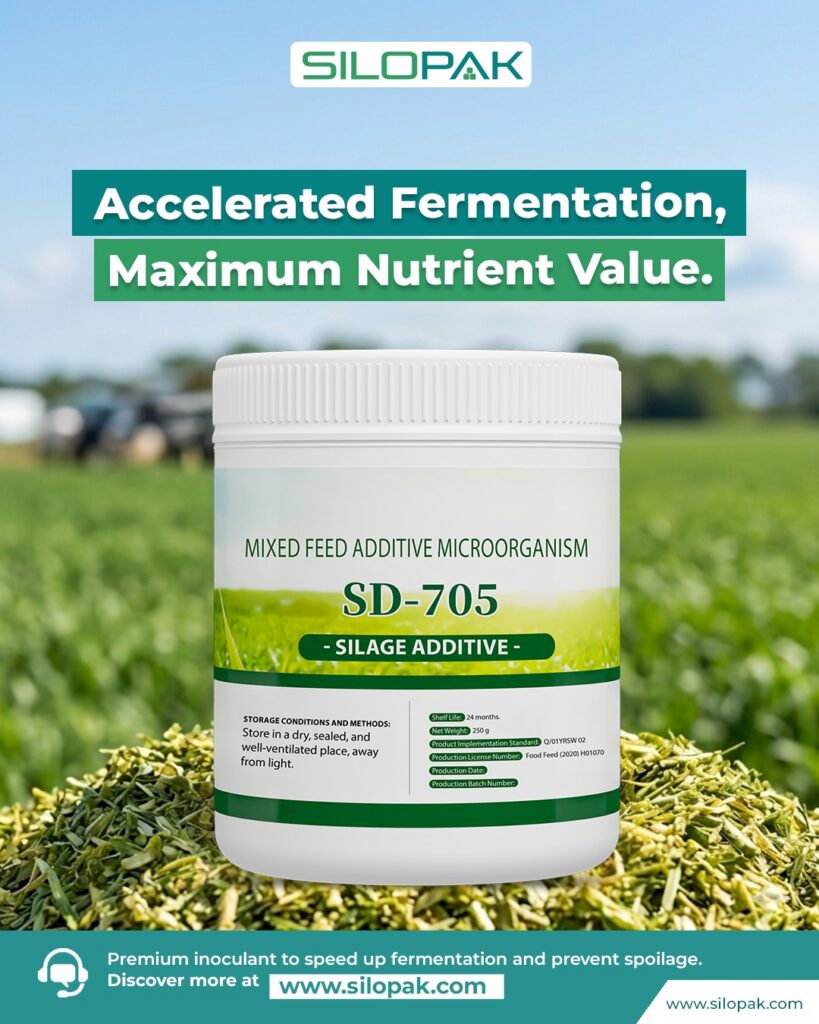
Natural inoculants are suitable for various types of forage including grass, corn, and legumes. Their application is relatively easy and efficient. Silopak’s own SD-705 Silage Fermentation Agent is an example of a natural lactic acid bacteria inoculant, combining selected strains of Lactobacillus buchneri, Lactobacillus plantarum, and Pediococcus pentosaceus to deliver consistent organic fermentation.
Organic-Based Enzymes
Organic enzymes break down complex fibers, thereby increasing the availability of sugar. Fermentation bacteria need sugar to accelerate the fermentation process. The use of organic enzymes increases the digestibility of silage, making it easier for livestock to absorb nutrients, which in turn improves feed efficiency.
Organic enzymes also help reduce coarse fiber residue. This is particularly important in intensive livestock systems because it has a direct positive effect on livestock performance. Enzyme additives are most beneficial for high-fiber forages where additional fermentable sugar is needed to support robust lactic acid production.
Natural Organic Acids
The use of natural organic acids suppresses the growth of spoilage bacteria, thereby stabilizing the pH of silage. Organic acids are particularly good at controlling spoilage and preventing silage from becoming moldy when exposed to air at feed-out. Because they are naturally derived, these acids are safe for livestock and leave no harmful residue, making them ideal for farms that prioritize feed safety and product integrity.
Matching the Organic Additive to Your Forage
The right organic additive depends on the type of forage, its moisture content, and its natural sugar content. Selecting the wrong type wastes money and delivers limited benefit. The table below provides general guidance.
| Forage Type | Main Challenge | Recommended Organic Additive |
|---|---|---|
| Maize / Corn | High sugar, good natural fermentation | LAB inoculant (for consistency and aerobic stability) |
| Grass | Variable sugar, moderate moisture | LAB inoculant, enzyme support if high fiber |
| Legumes (lucerne, cowpea, clover) | Low sugar, high protein, hard to ferment | LAB inoculant plus enzyme or organic acid support |
| High-fiber mixed forage | Insufficient fermentable sugar | Organic enzyme to release sugar from fiber |
| Wet forage / high rainfall regions | High spoilage and mold risk | Natural organic acid for spoilage control |
“The move toward organic additives is not just about marketing or following a trend. Buyers in regulated export markets increasingly require documentation that feed inputs leave no harmful chemical residue. A natural lactic acid bacteria inoculant achieves the fermentation control farmers need while keeping the whole feed chain clean. For operations thinking about long-term product integrity, that distinction matters more every year.”
— Sue Su, Marketing Director of Silopak
Impact on Feed Quality and Livestock Performance
The use of organic silage additives improves silage quality because they preserve important nutrients in the feed, such as protein and energy. Stable silage conditions increase palatability, making livestock more eager to consume the feed. This is crucial for maintaining consistent nutrient intake.
High-quality feed improves livestock performance and reduces the risk of digestive disorders. As a result, livestock weight gain remains stable and milk production can be maintained at consistent levels. This has a positive ripple effect on overall feed management, because farmers no longer have to frequently discard silage due to spoilage, which directly increases operational efficiency.
To get the full benefit of any organic additive, the physical anaerobic barrier must also be maintained. Even the best natural inoculant cannot compensate for a poor seal, which is why pairing organic additives with quality LLDPE silage film is essential for a complete fermentation system.
How to Select Organic Additives Responsibly
Organic additives must be selected carefully. The priority considerations are the type of forage, the moisture content, and the sugar content of the material. It is important for farmers to understand the purpose of use, whether the goal is to accelerate the fermentation process or to increase digestibility. Each objective requires a different approach and a different category of additive.
Another consideration is the quality of the organic materials in the additive itself. Farmers must ensure that the additive comes from a reliable source and that the production process complies with feed safety standards. The application method must also be clear, including the appropriate dosage to ensure optimal fermentation. Underdosing limits effectiveness, while overdosing wastes money and can interfere with natural fermentation balance.
Sustainability and Long-Term Value
Modern farming practices increasingly emphasize sustainability, and the use of organic additives aligns directly with this concept because it is more environmentally friendly than synthetic alternatives. Organic additives also help maintain food chain safety by minimizing chemical residue levels, which is increasingly important for improving the quality and marketability of livestock products.
In the long term, this approach contributes to maintaining soil and environmental health. Reducing feed waste through stable fermentation is itself an environmental benefit, lowering the rate of resource consumption per unit of usable feed. This adds value that benefits the farm, the livestock, and the wider environment at the same time.
Organic silage additives are a natural solution for improving silage quality. They have been shown to stabilize the fermentation process, and feed nutrient content is better preserved because they minimize the risk of decay. With proper selection and disciplined use, organic additives can improve feed efficiency and consistently enhance livestock performance. For livestock farmers seeking to improve feed quality while supporting sustainable practices, organic additives are a sound choice as part of a long-term silage management strategy.
Frequently Asked Questions about Organic Silage Additives
Q: What is the difference between organic and chemical silage additives?
Organic silage additives are derived from natural sources such as selected lactic acid bacteria, plant-based enzymes, and naturally occurring organic acids. They control fermentation through biological mechanisms and leave no harmful synthetic residue in the feed. Chemical additives, such as certain mineral acids, are manufactured compounds that suppress spoilage through direct chemical action. While effective, they can be corrosive to handle, may reduce palatability at higher doses, and can leave chemical residues in the feed chain. For farms prioritizing feed safety, environmental responsibility, and export market compliance, organic additives are generally the preferred choice.
Q: Do organic silage additives work as well as chemical ones?
For most forage types under good ensiling conditions, organic additives, particularly natural lactic acid bacteria inoculants, are highly effective at driving rapid pH reduction and stable fermentation. They achieve results comparable to chemical additives in terms of preserving nutrients and reducing dry matter loss. The main situation where chemical acids may have an edge is in very wet conditions or with extremely difficult-to-ferment material, where rapid direct acidification is needed. However, for the large majority of silage operations, a well-chosen organic inoculant or enzyme combination delivers excellent and reliable results without the drawbacks of synthetic chemicals.
Q: Are organic silage additives safe for all livestock?
Yes. Organic silage additives based on lactic acid bacteria, natural enzymes, and naturally derived organic acids are safe for all classes of livestock, including dairy cows, beef cattle, sheep, goats, and horses. Because they leave no harmful synthetic residue, they do not pose the contamination risks that some chemical additives can introduce into the feed chain. This makes them particularly suitable for farms producing milk and meat for markets with strict residue and food safety standards.
Q: Which organic additive should I use for low-sugar crops like legumes?
Low-sugar, high-protein crops such as lucerne, cowpea, and clover are naturally difficult to ferment because they lack sufficient water-soluble carbohydrates to fuel rapid lactic acid production. For these crops, the best approach is a lactic acid bacteria inoculant combined with an organic enzyme. The enzyme breaks down complex fibers to release additional fermentable sugar, while the inoculant ensures that lactic acid bacteria dominate the fermentation. In some cases, an organic acid additive can also be used to provide additional spoilage control during the critical early fermentation phase.
Q: Do organic additives leave any residue in milk or meat?
Properly formulated organic silage additives based on natural bacteria, enzymes, and organic acids do not leave harmful residues in milk or meat. This is one of their primary advantages over synthetic chemical additives. The lactic acid bacteria and enzymes work within the silage during fermentation and do not transfer problematic compounds into the animal or its products. This residue-free profile is increasingly important for producers supplying processors and retailers with environmental and food safety reporting requirements.
Q: How do organic silage additives support sustainable farming?
Organic silage additives support sustainability in several ways. They reduce feed spoilage and dry matter loss, which means fewer resources are consumed per unit of usable feed produced. They are biodegradable and do not introduce synthetic chemicals into the soil or feed chain. By improving feed quality consistency, they also support better livestock performance, which improves the overall resource efficiency of the operation. Over the long term, reduced feed waste and lower chemical input both contribute to maintaining soil and environmental health, aligning silage production with broader sustainable agriculture goals.
This article was last reviewed and updated by the Silopak Editorial Team on April 24, 2025. Our team periodically revisits published content to ensure accuracy, relevance, and alignment with current best practices in livestock feed management and silage preservation.